
The $500 Billion Question
Is the AI capex boom rational, and how much AI revenue must ultimately exist?

Every capital cycle gets asked the same question, and never at the beginning. Railways, fibre, shale and now AI compute all followed one sequence: a genuine breakthrough, a land grab by well-capitalised incumbents, a financing boom that pulls in players who cannot fund it from cash flow, and then — usually late — the arithmetic. This piece runs the arithmetic. It argues neither that the buildout is a bubble nor that it is obviously rational.
1. The scale of what has been committed
Amazon, Alphabet, Microsoft and Meta have guided to roughly $630–725 billion of combined capital expenditure in 2026, up from about $390–410 billion in 2025. Add Oracle, the neoclouds and new entrants and 2026 AI-attributable capex lands near $850 billion. Consensus for 2027 sits above a trillion.
The least-discussed entrant is SpaceX. Following the xAI combination it disclosed $18.4 billion of capex in the second quarter of 2026, of which $15.8 billion was AI — roughly six times its connectivity and space segments combined, and more than double the prior quarter. It is funded by a Starlink business reporting $7.81 billion of quarterly revenue, up 92% and ahead of consensus; the shares fell anyway, on the capex line. SpaceX has also filed with the FCC for up to one million orbital data-centre satellites, with compute payloads targeted from 2028.
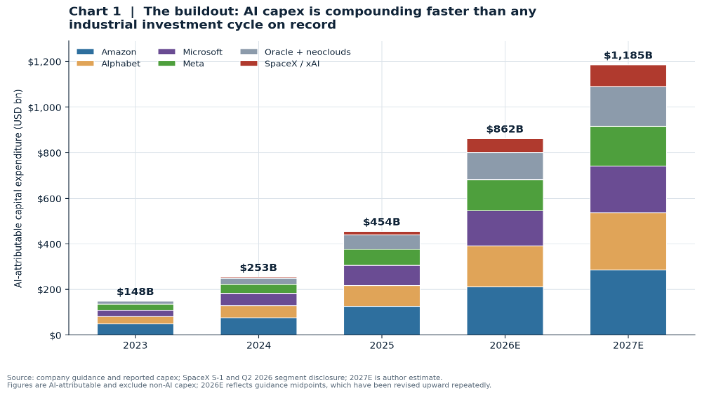
Chart 1 — AI-attributable capex by player. Source: company guidance and disclosure; 2027E author estimate.
Two features matter more than the level. Spending is accelerating, not merely high, so the hurdle is a moving target. And the composition has changed: in 2023 this was four cash-rich incumbents self-funding; by 2026 roughly a quarter of the spend comes from entities that must raise external capital. Global AI-related debt issuance is on track for near $570 billion this year, with an estimated $800 billion of data-centre financing in private credit and off-balance-sheet vehicles.
